

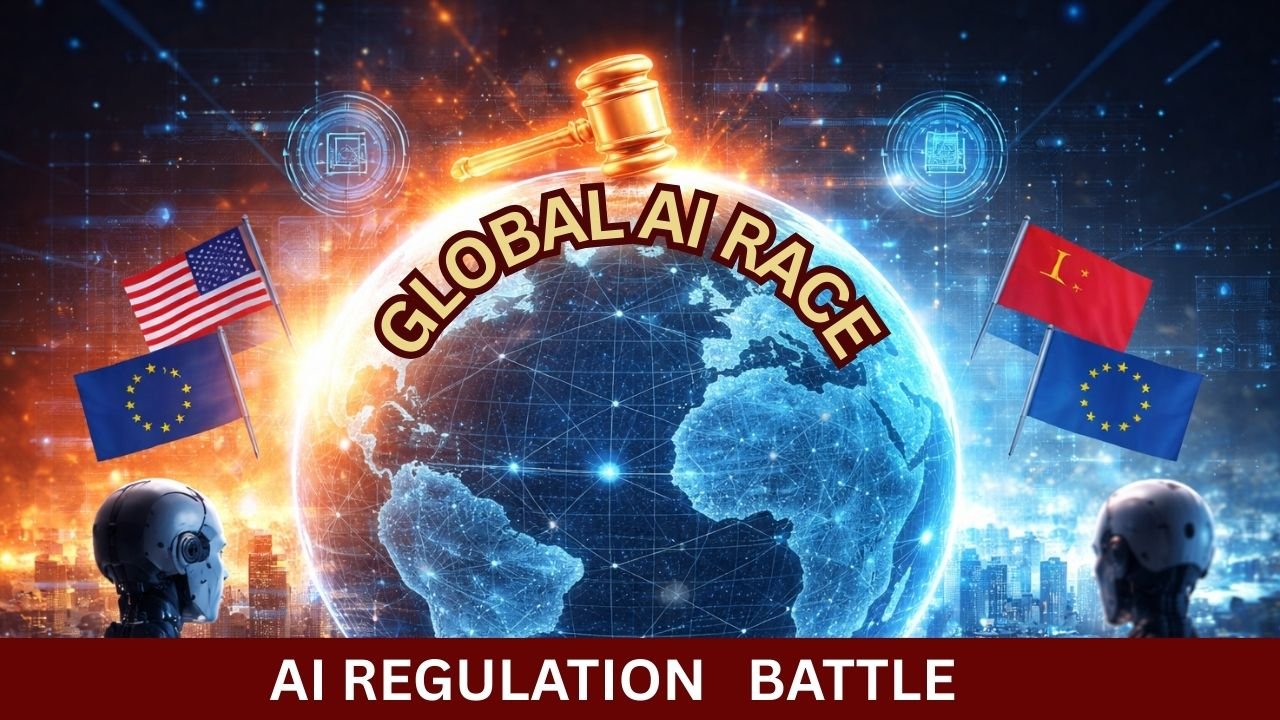
Global AI Race Intensifies as Governments Tighten Regulations and Tech Giants Expand Power
Global AI race: The global race to dominate artificial intelligence is accelerating at an unprecedented pace, prompting governments across the United States, Europe, and Asia to tighten regulatory oversight even as technology giants rapidly expand their AI capabilities. As companies such as Google, Microsoft, OpenAI, and several Chinese tech firms pour billions into advanced AI systems, policymakers are increasingly grappling with how to balance innovation with safety, security, and economic stability.
Artificial intelligence has quickly moved from a futuristic concept to the central battleground of technological and economic competition. From generative AI models capable of writing complex code to advanced tools transforming healthcare, finance, and manufacturing, the technology is reshaping industries at a speed regulators are struggling to match.
Global AI race: Governments Move Toward Stronger AI Regulation
In recent months, governments around the world have intensified discussions on how to regulate powerful AI systems without stifling innovation. The European Union has already taken a major step forward with its comprehensive AI Act, which introduces strict rules on high-risk AI applications, including biometric surveillance, critical infrastructure systems, and automated decision-making tools.
The United States, while taking a more flexible approach, has also increased scrutiny over the development and deployment of advanced AI models. Washington has been working with major technology companies to establish voluntary safety commitments, including transparency in AI training data and safeguards against misuse.
Meanwhile, Asian countries such as China, Japan, and South Korea are rapidly advancing their own regulatory frameworks. China has already implemented regulations governing generative AI services, requiring companies to ensure that AI-generated content aligns with national guidelines and security requirements.
These regulatory efforts highlight a growing global consensus: artificial intelligence is too powerful to remain entirely unchecked.
Global AI race: Big Tech Expands Its AI Dominance
At the same time, major technology companies are racing to strengthen their position in the AI economy.
Microsoft has deepened its partnership with OpenAI, integrating advanced AI tools across its software ecosystem, including productivity platforms and cloud services. Google has similarly expanded its AI models and continues to embed generative AI features across its search engine, advertising systems, and enterprise tools.
Amazon, Meta, and Apple are also investing heavily in AI research and infrastructure, particularly in cloud computing and machine learning platforms.
In China, companies such as Baidu, Alibaba, and Tencent are developing their own large language models and AI ecosystems to compete with Western technology leaders.
Industry analysts estimate that global investments in artificial intelligence could exceed $300 billion annually by the end of the decade, reflecting the strategic importance of the technology for future economic growth.
Start-ups Caught Between Opportunity and Regulation
While the AI boom has created enormous opportunities for start-ups, stricter regulatory frameworks could also present new challenges for smaller technology companies.
Start-ups often lack the resources of large tech firms to comply with complex regulatory requirements, such as auditing AI models, documenting training data, or implementing safety safeguards. As a result, some experts fear that overly strict rules could unintentionally strengthen the dominance of established technology giants.
At the same time, many emerging AI companies are benefiting from surging investor interest. Venture capital funding for AI start-ups has continued to grow, particularly in sectors such as healthcare AI, robotics, financial technology, and cybersecurity.
Economic and Geopolitical Implications
Beyond the technology sector, the AI race is also becoming a central factor in global geopolitics.
Governments increasingly view artificial intelligence as a strategic technology capable of shaping economic power, national security, and global influence. The competition between the United States and China, in particular, has intensified as both nations seek leadership in advanced computing, semiconductor manufacturing, and AI research.
Experts believe the outcome of this race could determine which countries dominate the digital economy in the coming decades.
At the same time, policymakers face a delicate balancing act: encouraging rapid innovation while ensuring that AI systems remain transparent, accountable, and safe.
The Road Ahead for Artificial Intelligence
As artificial intelligence continues to transform economies and societies, the debate over regulation is expected to grow even more intense. Governments are likely to introduce new rules addressing issues such as data privacy, algorithmic bias, misinformation, and the potential impact of AI on employment.
Technology companies, meanwhile, are expected to accelerate their investments as they compete for leadership in what many experts describe as the most important technological revolution since the internet.
For businesses, policymakers, and consumers alike, the global AI race is no longer a distant future scenario — it is already reshaping the world today.
Also Read:
Pakistan Oil Crisis: Schools Shut for Two Weeks as Energy Shortage Worsens
About the Author





1 thought on “Global AI Race Intensifies as Governments Tighten Regulations and Tech Giants Expand Power”